
PhD student
LAMBE, Université d'Evry Val d'Essonne
Evry, France
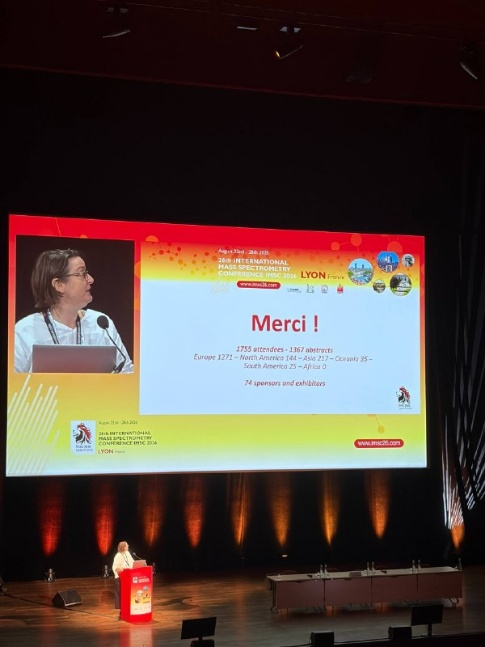 Thanks to the French Proteomics Society, I had the great pleasure of attending the 26th International Mass Spectrometry Conference (IMSC 2026), held in Lyon from 22 to 28 August 2026. This edition was the largest IMSC to date, bringing together around 1,800 participants from five continents and creating an excellent opportunity to connect with leading scientists and researchers in mass spectrometry from around the world. It was a week filled with science, inspiring discussions, new connections, and memorable moments.
The conference opened with a very welcoming ceremony led by IMSC 2026 Chair Isabelle Compagnon, IMSF President Ron M. A. Heeren, SFSM President Joëlle Vinh, and Swiss Group for Mass Spectrometry President Yury Tsybin, who brought along the traditional SGMS cowbell.
The congress offered an impressive range of scientific sessions and workshops, covering topics from the latest developments in mass spectrometry instrumentation to its applications in clinical research, archaeology, and sustainability. The scientific program was well balanced between methodological advances and biomedical applications, providing valuable insights into both fundamental and translational research.
 The sessions that were particularly relevant to my research included Biomolecular and Non-Covalent Complexes, (Glyco)proteomics, and Chemical and Multimodal Approaches, featuring excellent speakers such as Michal Sharon and Peter Novak. I was also inspired by the plenary lectures, including Richard O’Hair’s presentation on mass spectrometers as complete chemical laboratories and Anouk Rijs’ talk on how advanced mass spectrometry approaches can be used to detect early protein aggregates associated with Parkinson’s disease.
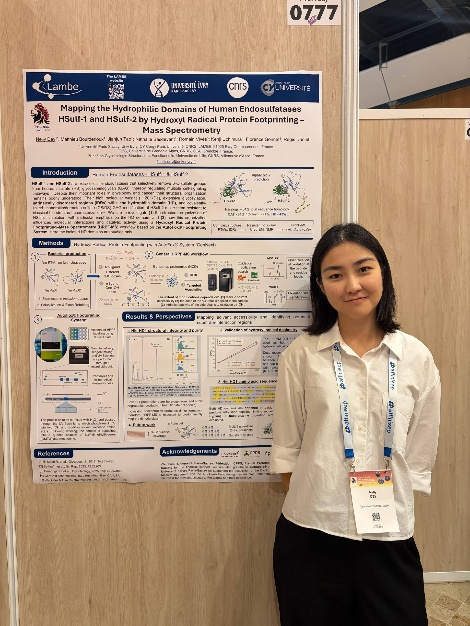
I also had the opportunity to present my PhD research during one of the poster sessions: "Mapping the Hydrophilic Domains of Human Endosulfatases HSulf-1 and HSulf-2 by Hydroxyl Radical Protein Footprinting–Mass Spectrometry". Presenting my work allowed me to receive valuable feedback, exchange ideas with researchers working in related fields, and discuss potential approaches.
Before the conference, I attended the Biopharmaceutical and Native MS Short Course, led by Julien Marcoux (IPBS Toulouse) and Joseph Gault (AstraZeneca). The course focused on native MS and HDX-MS and their applications in both academic and industrial settings, with an emphasis on addressing real-world questions related to therapeutic and membrane proteins. The program concluded with presentations from invited speakers from the biopharmaceutical industry, followed by a round-table discussion. This course further strengthened my interest in an integrative structural proteomics approach - understanding how complementary techniques can provide a more comprehensive picture of protein structure and dynamics, and how these approaches are applied in industry.
 Another particularly valuable aspect of IMSC 2026 was the launch of YIMS (Young International Mass Spectrometry Society), with strong support from Isabelle Compagnon. YIMS brings together and represents young researchers from the DGMS, CJSM, and young NVMS communities across Germany, France, and the Netherlands. The initiative organized several activities aimed at supporting early-career researchers and creating opportunities for networking, including flash and full talks, a networking workshop, and a social gathering with YIMS participants. Thanks to these activities, I was able to establish several valuable connections with other young researchers and learn about potential future opportunities.
Overall, attending IMSC 2026 was a highly enriching experience, both scientifically and personally. I gained new perspectives on mass spectrometry and structural proteomics, received valuable feedback on my PhD research, and expanded my professional network. I am very grateful to the French Proteomics Society for the travel grant, which made my participation in this international conference possible.