
Master 2 apprentice,
Proteom’IC core facility, Institut Cochin, Universite Paris Cite
Paris, France
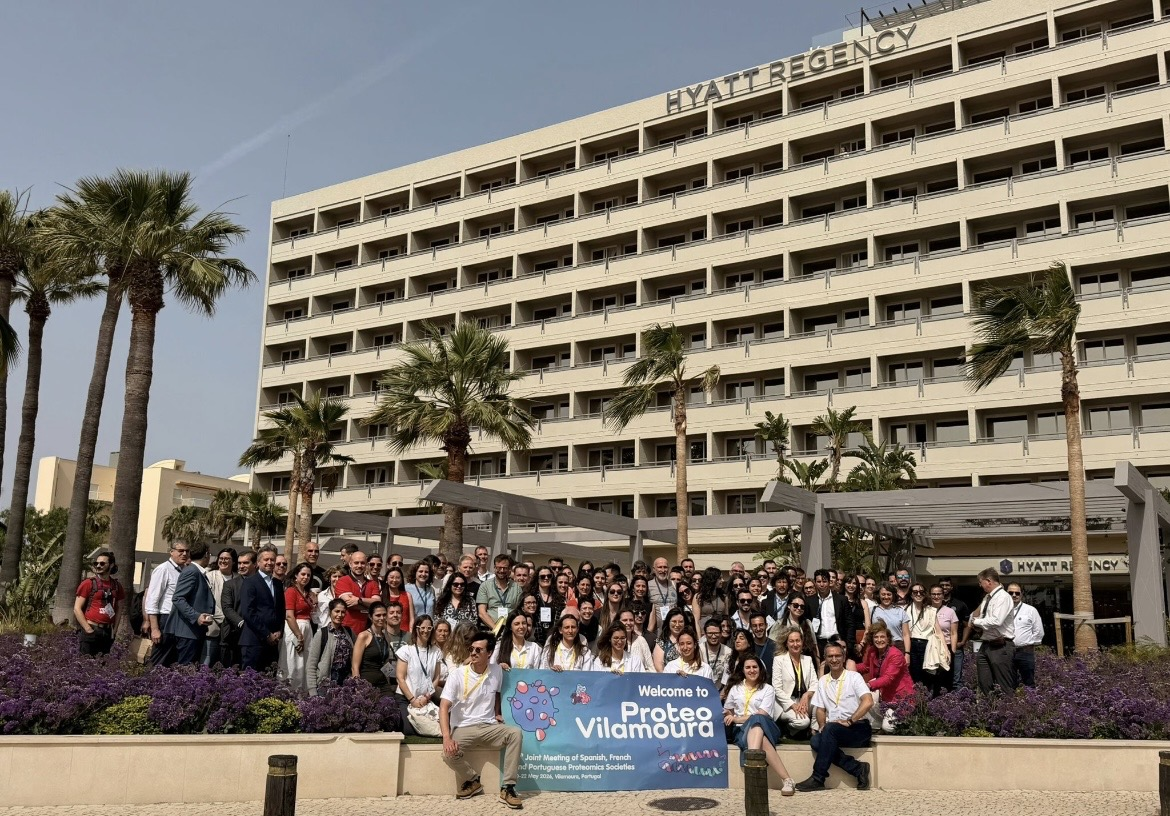
I had the pleasure of attending ProteoVilamoura 2026, the 6th Joint Meeting of the Portuguese, Spanish and French Proteomics Societies, held in Vilamoura from 20 to 22 May 2026. More than a succession of talks, the congress felt like a place where different ways of doing proteomics could meet: clinical applications, technological developments, biological questions, and computational approaches were constantly brought into dialogue.
What struck me most was the variety of scales at which proteomics was discussed. The congress opened with an invited lecture by Nelson Soares on red blood cell proteomic profiling combined with deep machine learning to identify potential diagnostic biomarkers for acute venous thromboembolism. I found this presentation particularly interesting because it showed how proteomics can be pushed beyond protein identification and quantification, towards prediction, classification and clinical decision-making. It also echoed many of the questions I am currently interested in: how can we make proteomics data more interpretable, and how can computational approaches help extract useful biological or clinical information from complex datasets?
Several other presentations also stayed with me because of the diversity of biological contexts they addressed. Océane Girard presented her work on the proteome of human embryo implantation, highlighting new biomarkers and metabolic signatures in a field where molecular understanding is still developing. Hisham Altoufaily’s presentation on the links between metabolic dysregulation and epigenetic marks in Huntington’s disease was another example of how proteomics can help connect molecular mechanisms that are often studied separately. I appreciated this range of topics because it reminded me that proteomics is not only a technical field, but also a way of approaching very different biological problems through a common language of proteins, pathways and regulation.
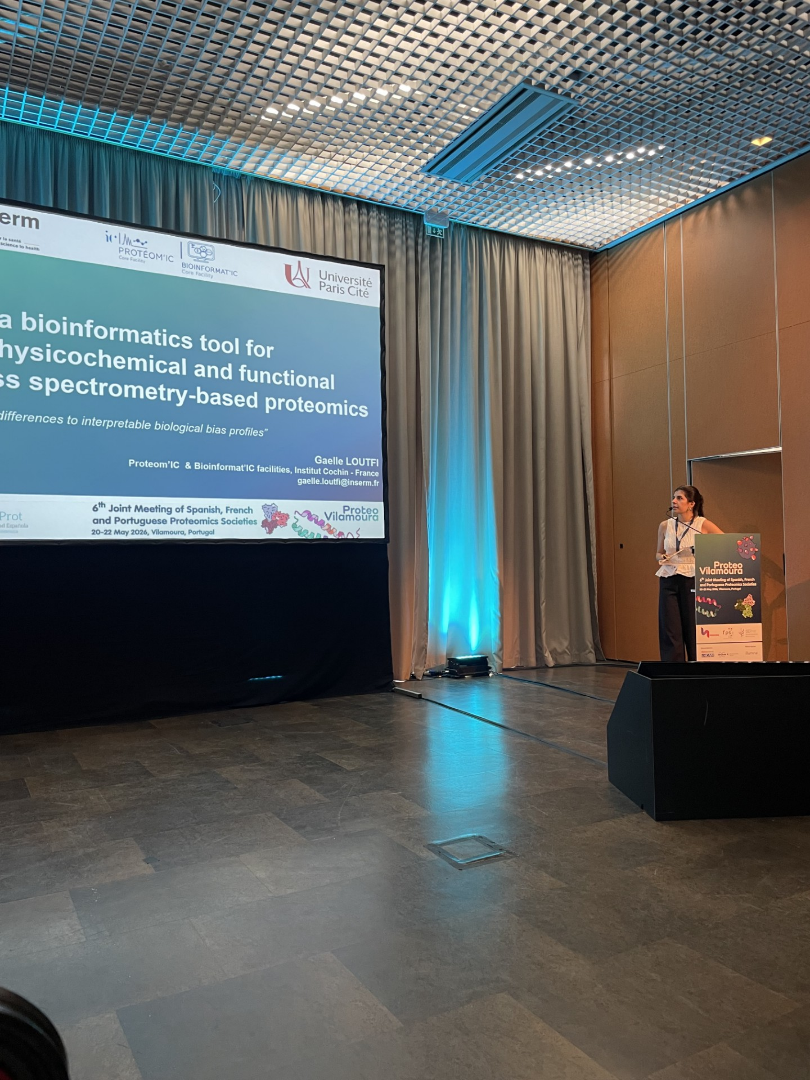
In this context, presenting my own work on BiasTracker was especially valuable. BiasTracker is a bioinformatics tool designed to detect, quantify and interpret experimental biases in bottom-up mass spectrometry-based proteomics. The project starts from a simple observation: not all proteins are detected with the same efficiency. Some may be absent or underrepresented in proteomics datasets not because they are biologically absent, but because their physicochemical properties make them more difficult to extract, digest, detect or quantify. BiasTracker therefore compares protein or peptide groups based on properties such as hydrophobicity, isoelectric point, molecular weight, charge and digestion-related features, and then links these differences to functional annotations.
I presented this work during the flash presentation session and through my poster. The flash format was a very useful exercise because it forced me to communicate the main idea of the tool clearly and quickly: moving from detection differences to interpretable bias profiles. The poster session then allowed for more detailed discussions around the workflow, the proof of concept on the “ghost proteome”, and the comparison of sample preparation protocols. These exchanges were probably the most useful part of the congress for me, because they helped me understand how experimental proteomics users perceive the tool, which parts of the workflow are intuitive, and which aspects still need to be made clearer.
 |
I particularly enjoyed the conversations around the poster because they were not limited to technical questions. Several discussions naturally moved towards broader issues: how to distinguish biological absence from technical non-detection, how to compare protocols without overlooking their biases, and how to make bioinformatics outputs useful for people who are not necessarily programmers. This was very encouraging, because it helped me see BiasTracker not only as a coding project, but as a communication tool between experimental design, mass spectrometry analysis and biological interpretation.
The atmosphere of ProteoVilamoura also made these exchanges easier. The meeting was friendly and open, with many opportunities to talk during poster sessions, coffee breaks and informal moments. As an early-career researcher, I found it motivating to be able to present my work, ask questions, and discuss ideas with people from different countries and with different scientific backgrounds. It also helped me practise explaining my project to a specialised proteomics audience, while adapting the level of detail depending on whether I was speaking to experimentalists, bioinformaticians or researchers focused on biological applications.
Overall, ProteoVilamoura 2026 was a very stimulating experience. It broadened my view of current proteomics research and reinforced the importance of developing computational tools that remain closely connected to experimental reality. The congress gave me useful feedback for the future development of BiasTracker, particularly regarding clearer visual outputs, additional annotation sources and better integration into existing proteomics workflows. I am very grateful to the French Proteomics Society for supporting my participation and giving me the opportunity to present my work and exchange with the proteomics community.
 |
Gaelle