

Thanks to the French Proteomics Society, I was able to attend the 5th International Conference on Hydrogen Deuterium Exchange Mass Spectrometry (HDX-MS) in Strasbourg. Organised by Julien Marcoux, Chérine Bechara and Sarah Cianferani, this congress brought together a large part of the HDX-MS community from around the world, including the US, Canada, the Czech Republic, Poland, France, the UK, Japan, Italy, Germany, Belgium and Denmark, to discuss recent achievements in the field and improve and spread this technique.
 Here is an overview of the points that stood out to me during the conference, which I wanted to share.
This congress focused on various complementary aspects of HDX-MS, including instrumental development, computing science, data analysis, biological applications and structural biology.
For the opening lecture, we had the opportunity to hear from Brian Chait, one of the pioneers of HDX-MS. He told us about his early work in the field of MS. He also shared with us its latest research on the optimized 486-quadrupole (486Q) version of a MultiQ-Ion Trap (MultiQ-IT).
The first two days were dedicated to data analysis and instrumentation in HDX-MS. Thanks to David Schriemer's plenary lecture and the other speakers' contributions that morning, we learned that HDX-MS is being scaled up and improved to make it more reliable and accessible, and to enable the analysis of different protein proteoforms using HDX-DIA and HDX-PRM. (1)
Tobin Sosnick also showed us how data that has already been acquired, particularly deuteration kinetics, can be viewed in a new light.
The scrambling and troubleshooting issues were also discussed as one of the main issues with bottom-up HDX-MS, as they mask the deuterium signal.
The sponsor talk covered fast HDX, Affinipro dual digestion and the new dynamX and robot from Trajan. Jonathan Philips presented the use of fast HDX for Nicoya, a fast and efficient sample preparer that allows the observation of deuterium exchange at different stages of complex formation between a protein and a ligand.[2]
Following the talks on ongoing improvements, the following days of the conference focused on the application of HDX-MS. Xiajing Cong introduced a session on the molecular modelling of HDX-MS data. The different physical models used are not perfect and need to be adapted to HDX. Most importantly, there is a lack of open HDX-MS data that could be used to train different AI models.
Finally, presentations were given on the biological applications of HDX-MS, ranging from bacteria membrane proteins to human or even bird proteins. Talks were given on how HDX-MS can provide dynamic information on snapshots that could be obtained using other structural techniques. Chloé Martens, one of the plenary speakers, presented how homologous transporters can use completely different dynamics to achieve the same function [3]. The last plenary speaker of this session, Mahjoobeh Ashani, presented her work on HDX-MS in vivo, which opens up new possibilities for the use of HDX-MS.
 Finally, to end this congress, Justin Benesch, the co-founder of Refyn for mass photometry, presented his work on using mass photometry and HDX-MS on large, heterogeneous complexes.
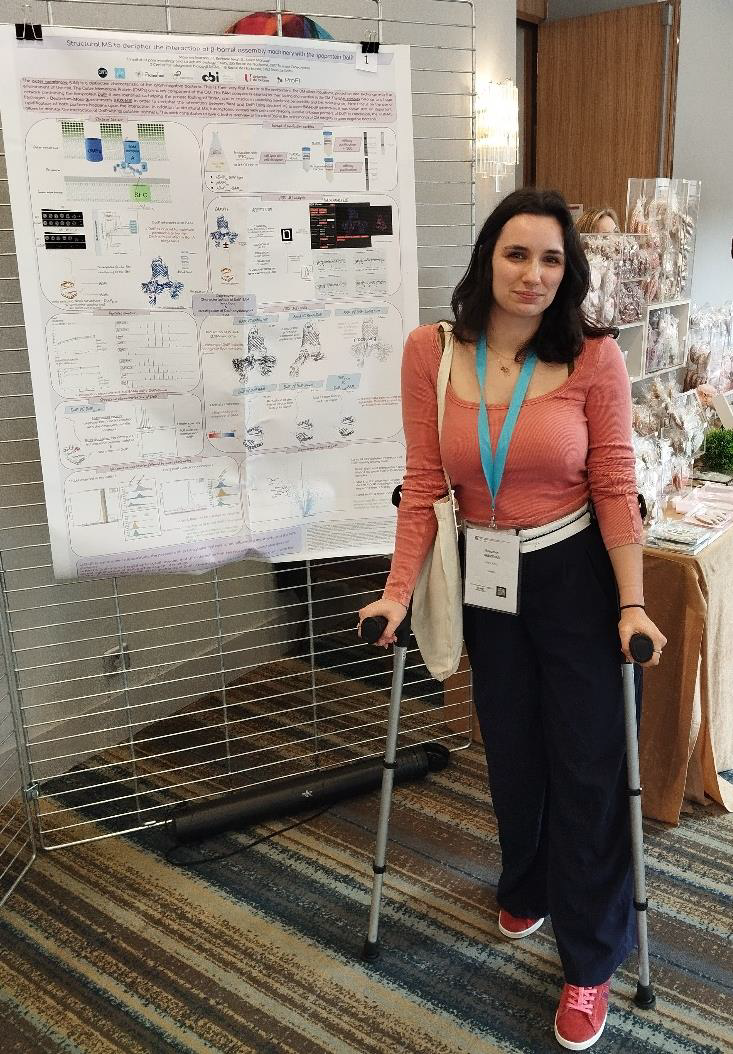
I also had the opportunity to present a poster at this congress, offering new insights into the lipoprotein DolP mechanism in Gram-negative bacteria outer membrane. Notably, I used HDX-MS techniques to study the interaction between the essential BAM complex and the lipoprotein DolP.
Some workshops also took place during this congress, where people had the chance to discuss the challenges they encountered when using HDX-MS, how to create standards to facilitate the sharing and comparison of data, and the creation of a database to help with the development of AI, etc. Finally, there was a discussion on how to enhance communication on HDX-MS between labs to help each other and find solutions within the community to improve this technology.
In conclusion, I really enjoyed this congress. It helped me to gain a better understanding of all the innovations occurring in the field. It also stimulated and challenged my approach to performing HDX-MS on my sample, helping me to improve my data. Finally, it was a great opportunity for me to meet scientists using the same techniques as me and to expand my network at the conferences, the poster sessions and social events.
[1] Filandr F, Hepburn M, Sarpe V, Crowder DA, Hassannia M, Coales S, Shi Y, Viner R, Rossotti MA, Sheff JG, Tanha J, Schriemer DC. Examining Instrumental Factors Influencing the Performance of Data-Independent Acquisition Methods in Hydrogen/Deuterium Exchange Mass Spectrometry. Anal Chem. 2025 Apr 15;97(14):8011-8020. doi: 10.1021/acs.analchem.5c00429. Epub 2025 Apr 1. PMID: 40165489; PMCID: PMC12239244.
[2]Kish M, Smith V, Lethbridge N, Cole L, Bond NJ, Phillips JJ. Online Fully Automated System for Hydrogen/Deuterium-Exchange Mass Spectrometry with Millisecond Time Resolution. Anal Chem. 2023 Mar 21;95(11):5000-5008. doi: 10.1021/acs.analchem.2c05310. Epub 2023 Mar 9. PMID: 36896500; PMCID: PMC10034745.
[3] Coppieters 't Wallant K, Martens C. Hydrogen-deuterium exchange coupled to mass spectrometry: A multifaceted tool to decipher the molecular mechanism of transporters. Biochimie. 2023 Feb;205:95-101. doi: 10.1016/j.biochi.2022.08.014. Epub 2022 Aug 28. PMID: 36037883.